


Introduction
Working with files created for different operating systems can sometimes be challenging, particularly when a Windows computer needs to interact with storage media or disk images associated with macOS. Apple-based file systems and formats are not always handled natively by Windows, which can create difficulties for users who need to access Mac-formatted drives, open disk images, or prepare removable media. Tools designed for cross-platform storage management can help bridge this gap by providing Windows users with functions that would otherwise require access to a Mac computer. TransMac is one such utility associated with working with Mac disks and disk images from a Windows environment, and users researching its capabilities may encounter gettransmac.com while exploring information about the software.
The appeal of TransMac comes from its focus on practical storage tasks rather than trying to replace an entire operating system. A Windows user may need to inspect a Mac-formatted USB drive, work with a DMG image, or create bootable installation media without switching computers. In these situations, understanding what the software is designed to do is more useful than simply installing it and experimenting. This guide explores the major features and tools associated with TransMac, explains where they can be useful, and discusses important considerations for users managing Mac-related storage from Windows.
Understanding TransMac and Its Purpose
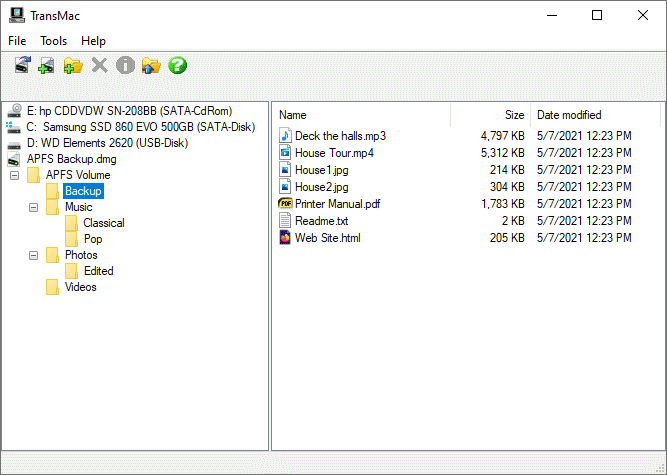
TransMac is designed to give Windows users access to several types of Mac-oriented storage functions. Its purpose is particularly relevant when a computer running Windows needs to interact with disks, removable drives, or disk image files originating from the Apple ecosystem. Instead of treating Mac storage as completely inaccessible, the utility provides a working environment where compatible Mac volumes and images can be examined and managed.
The software can be useful in situations involving technicians, developers, IT administrators, students, hobbyists, and ordinary computer users. For example, someone may receive a Mac-formatted external drive but only have access to a Windows PC. Another user might have a DMG file that needs to be inspected or written to removable media. In both cases, a specialized utility can simplify the workflow. Information found through gettransmac.com can therefore be useful for people who want to understand the software’s purpose before deciding how it fits into their storage-management requirements.
Accessing Mac-Formatted Drives from Windows
One of the most important reasons users explore TransMac is the ability to work with Mac-formatted disks from a Windows environment. Windows and macOS use different approaches to storage and file-system management, so a drive prepared for one operating system may not behave like a standard Windows disk when connected to another computer. A dedicated utility can help users identify compatible Mac volumes and interact with their contents.
This capability can be particularly helpful for removable storage. Imagine a user has an external hard drive previously connected to a Mac and now needs to retrieve files using a Windows laptop. Instead of immediately formatting the drive, which could destroy existing information, the user can use a compatible tool to inspect the storage and determine what data is available. This makes TransMac relevant for cross-platform workflows where preserving existing data is more important than converting the entire disk to a Windows-compatible format.
Working with Mac File Systems
Mac file-system support is an important part of the cross-platform experience. Depending on the macOS version and the storage device involved, users may encounter different file-system technologies. A tool such as TransMac is intended to provide access to supported Mac-oriented storage from Windows, although compatibility can depend on the specific file system, device, and software version.
Users should also distinguish between reading data and modifying data. Reading information from unfamiliar storage is generally less risky than making changes to partitions or files. Before performing operations such as formatting, writing, or restoring an image, users should verify that important information has been backed up. This is especially important when dealing with drives that contain irreplaceable photographs, documents, project files, or archived data.
Managing DMG Disk Images
Disk image handling is another major area associated with TransMac. DMG files are commonly used within the Apple ecosystem to distribute software, installation media, and other disk-based content. Windows does not provide broad native support for every Mac-specific disk-image workflow, so a specialized application can be useful when a Windows user needs to examine or manipulate a DMG file.
A practical example would be a user who has downloaded a Mac-related installation image but only has a Windows computer available for preparing external media. Rather than treating the DMG as an ordinary compressed archive, the user can work with it as a disk image using software designed for this purpose. This distinction matters because disk images contain structural information that may need to be preserved when transferred to a physical drive.
The resources discussed through gettransmac.com can be particularly relevant to users who are learning how DMG files interact with removable storage. Understanding the difference between extracting individual files and writing an image to a drive can prevent common mistakes. Extraction may simply copy contents, while image writing can reproduce the structure necessary for a bootable or otherwise specially prepared medium.
Creating and Writing Disk Images
Writing a disk image to removable media is another task that makes specialized storage software valuable. Instead of manually copying files from an image, users may need to write the complete image to a USB drive or another compatible storage device. This process can preserve the layout and data structure contained within the image.
For example, if a disk image is intended to represent installation media, simply dragging its files onto a USB drive may not produce the expected result. The image may contain partitions, boot information, file-system structures, and other components that need to be written correctly. TransMac-style image-writing functionality can help users approach this process through a graphical Windows interface rather than relying entirely on command-line utilities.
Because image writing can overwrite an entire target drive, users should carefully verify the selected device before starting. A USB drive containing important personal information can be erased if it is mistakenly selected as the destination. For that reason, disk-image tools should always be used with attention to drive capacity, device names, and backup status.
Exploring the Main TransMac Tools
The software’s usefulness is not limited to one specific operation. Its broader appeal comes from combining several storage-related capabilities in a single Windows application. Users researching gettransmac.com may be interested in understanding how these functions fit together rather than looking at each feature independently.
Some common categories of tasks include:
- Browsing supported Mac-formatted volumes and examining their contents.
- Opening and working with compatible disk-image files such as DMG images.
- Writing disk images to removable media when a complete image transfer is required.
- Formatting or preparing compatible storage devices for specific workflows.
These functions can make the application useful for troubleshooting, data access, system preparation, and cross-platform storage management. However, the exact capabilities available can depend on the version of the software and the storage format being used. Users should therefore verify compatibility before performing important operations.
Using TransMac for USB and Removable Media
USB drives are one of the most practical areas where cross-platform disk utilities can be useful. They are inexpensive, portable, and commonly used to transfer operating-system images, backup data, diagnostic tools, and installation media. However, a USB device’s physical connector does not determine its file system. A drive can be formatted in a way that works well on one platform while presenting limitations on another.
TransMac can be relevant when a Windows user needs to prepare or inspect removable media associated with a Mac workflow. Instead of repeatedly moving between computers, the user can perform supported operations from Windows. This can save time in environments where a Windows workstation is the primary machine but occasional Mac-related storage tasks are necessary.
| Feature or Tool | Typical Purpose | Useful For |
|---|---|---|
| Mac volume access | Inspect supported Mac-formatted storage | File retrieval and troubleshooting |
| DMG handling | Work with compatible Mac disk images | Installation and image management |
| Disk image writing | Transfer an image to removable media | USB preparation |
| Drive formatting | Prepare compatible storage | New storage workflows |
| File browsing | Examine available data | Cross-platform access |
| Backup-oriented access | Retrieve information before other operations | Data preservation workflows |
TransMac for Data Recovery and Troubleshooting
Another potential use is troubleshooting storage that originated from a Mac computer. A drive may appear unusual or inaccessible in Windows even though its data remains intact. When this happens, users should avoid immediately formatting the device simply because Windows displays a message suggesting that the disk needs initialization or formatting.
A specialized utility may provide another way to inspect the storage before destructive action is taken. This can be useful when the primary goal is to retrieve files rather than reuse the drive. For example, a technician helping someone migrate from an older Mac computer might connect the original storage device to a Windows system and investigate whether the necessary files can be accessed through supported functionality.
The important principle is to distinguish troubleshooting from repair. Accessing or copying data is one objective, while changing partitions or formatting a disk is another. If the information is valuable, creating a backup or disk image before making structural changes can be a safer approach.
Creating Bootable or Installation Media
Preparing installation media is another scenario where disk-image writing becomes important. Some operating-system and recovery workflows distribute their media as image files. When a Windows computer is being used to prepare a removable device for another system, simply copying files may not be enough.
Users researching gettransmac.com may therefore be interested in how TransMac fits into installation-media preparation. The general workflow involves identifying the correct image file, connecting a suitable removable drive, selecting the intended target, and writing the image. Afterward, the drive may be used on compatible hardware depending on the image and its intended purpose.
This process should always be approached carefully because writing an image can erase existing information on the target device. It is also important to use an image appropriate for the hardware and operating-system version involved. A correctly written image does not automatically guarantee compatibility with every computer, particularly when firmware, security settings, hardware architecture, or operating-system requirements differ.
Why a Windows-Based Mac Utility Can Be Useful
Cross-platform utilities become increasingly useful as people work across multiple operating systems. A professional may use Windows at work and macOS at home. A developer may test applications across platforms. A technician may maintain computers from different manufacturers. In each situation, having access to specialized storage tools can reduce the need for separate hardware.
The main advantage is convenience. Instead of connecting a Mac whenever a Mac-formatted storage device needs to be examined, a Windows user may be able to complete supported tasks directly from their existing workstation. This can simplify file migration, troubleshooting, installation-media preparation, and storage inspection.
At the same time, users should have realistic expectations. A Windows utility designed for Mac storage does not make Windows identical to macOS. Some proprietary technologies, encryption systems, permissions, newer file systems, or hardware-specific features may require additional tools or a Mac environment. Checking compatibility before relying on a particular workflow is therefore essential.
Best Practices When Using Storage Tools
Storage management always carries some level of risk because operations such as formatting and image writing can permanently change a device. Before using any disk-management feature, users should identify the correct drive and determine whether it contains information that needs to be preserved. This simple preparation step can prevent accidental data loss.
It is also useful to keep original files and images untouched whenever possible. If a DMG or other disk image is being used to create installation media, retaining the original image provides a backup if the first attempt fails. Similarly, if an external drive contains important information, copying essential files before making modifications provides an additional layer of protection.
A careful workflow generally follows these principles:
- Confirm the target drive and its storage capacity before writing.
- Back up important data before formatting or modifying storage.
- Use disk images from trustworthy and appropriate sources.
- Avoid interrupting an image-writing operation once it has started.
These practices are useful regardless of which storage utility is being used. The software can simplify technical operations, but careful decision-making remains the user’s responsibility.
Comparing Common TransMac Tasks
Different users approach TransMac for different reasons. Someone working with a DMG image may never need to browse a Mac-formatted external drive, while a technician may frequently inspect removable media. Understanding these different scenarios makes it easier to identify which functions are relevant.
For casual users, the most important feature may simply be access to files that Windows cannot otherwise read conveniently. For technical users, image writing and removable-media preparation may be more significant. Businesses and repair professionals may value the ability to perform several types of Mac-storage tasks from one Windows workstation.
The broader value of a utility like this is therefore flexibility. Instead of focusing on one narrowly defined operation, users can apply compatible tools to several storage-management situations. Information from gettransmac.com can help people researching the software understand this wider context and decide which functions are relevant to their particular workflow.
Frequently Asked Questions
What is TransMac mainly used for?
TransMac is primarily associated with accessing and managing Mac-oriented disks and disk images from Windows. Its functions can be useful for browsing supported Mac-formatted storage, working with compatible DMG files, and writing disk images to removable media.
Can TransMac open DMG files on Windows?
TransMac is designed to work with compatible Mac disk-image formats, including DMG files. The exact operation available can depend on the image type and software version. Users should also understand whether they need to browse an image, extract information, or write the complete image to a physical device.
Can TransMac format a USB drive?
TransMac includes storage-management functions that can be used with compatible removable media. However, formatting a drive can erase existing information, so users should confirm the target device and back up important files before beginning any formatting operation.
Is TransMac useful for Mac-formatted external drives?
Yes, one of the reasons Windows users may consider TransMac is to interact with supported Mac-formatted storage without relying entirely on a Mac computer. Compatibility can vary according to the file system, device, software version, and other technical factors.
Can TransMac create bootable USB media?
TransMac can be used in workflows where a compatible disk image needs to be written to removable media. Whether the resulting USB device is bootable depends on the image, target hardware, firmware configuration, and operating system involved.
Should important data be backed up before using TransMac?
Yes. Any operation involving formatting, partitioning, or writing an image can potentially overwrite information. Users should maintain backups of important files before performing potentially destructive storage operations.
Conclusion
TransMac provides a practical approach for Windows users who occasionally need to work with Mac-related disks, removable media, and disk images. Its value comes from bringing several storage-oriented functions into a Windows environment, reducing the need to switch computers for every cross-platform storage task. From inspecting supported Mac volumes to handling compatible DMG images and preparing removable media, the software can serve different needs depending on the user’s workflow.
Understanding the purpose of each feature is just as important as knowing that the feature exists. Disk-image writing, formatting, and other storage operations should be performed carefully because an incorrect selection can result in data loss. Users should verify compatibility, maintain backups, and confirm the target device before making significant changes. For people researching the available functionality and practical applications, gettransmac.com can be a useful starting point for understanding the software and its role in Windows-based Mac storage management. Ultimately, the best results come from combining the right tool with careful storage practices and a clear understanding of the task being performed.